Digital exhibition — homepage
Divine Machinery
A study on divine machinery.
Final Project Proposal: Aura After the Machine
My final project will examine Divine Machinery, an emerging cross-media aesthetic in which technology, machinery, bodily transformation, and religious imagery overlap. The project will focus on works such as Nam June Paik's TV Buddha, Shilpa Gupta's Blessed Bandwidth, Stane Jagodič's digital constructivist works, Agnes Questionmark's Liquid Ground, Madeleine Carrington's The Mercy Program, and digital projects connected to artists such as Maggie Dunlap and Hakita. These works do not form a conventional art movement with a shared manifesto, location, or group of artists. Instead, they have been retrospectively connected through recurring qualities such as sacred imagery, technological awe, ritual, feedback loops, transhumanism, and the fusion of machinery with the body.
My central research question is: What happens to artistic aura when machinery ceases to function only as a means of reproduction and instead becomes the source, vessel, or subject of sacred presence? Walter Benjamin associated aura with an artwork's unique existence in a particular time and place. Mechanical reproduction destabilized this authority by allowing images to circulate beyond their original contexts. Divine Machinery appears to emerge after this loss of uniqueness. However, I argue that these works do not simply eliminate aura. Instead, they relocate it into technological systems: screens, networks, feedback loops, interfaces, artificial bodies, and digital environments. In TV Buddha, for example, the work's strange contemplative presence is created through the circuit connecting the statue, camera, television, and live image. In Blessed Bandwidth, religious blessing is transmitted through a digital interface rather than experienced only at a sacred physical site.
The final project will take the form of an interactive digital essay combining several visualization methods. Namely, a Flourish heatmap will compare selected works across qualities such as sacred imagery, machine-body fusion, ritual, digital space, feedback, technological awe, and bodily horror. Each quality will be coded on a defined scale from absent to defining. I intend this visualization to help test whether Divine Machinery has a consistent conceptual structure or is better understood as a loose category based on overlapping similarities.
Then, I plan to use ArcGIS StoryMap to trace the different geographical and cultural contexts from which these works emerge. Rather than treating location as simple biographical information, the map will examine how technological spirituality changes across Buddhist, Christian, posthuman, and internet-based contexts. The story will gradually move from identifiable physical locations toward cyberspace as a distributed and partially un-mappable environment. I may also incorporate TimelineJS to show how many works predate the recent category of Divine Machinery, suggesting that the aesthetic has been constructed retrospectively through digital circulation.
I will evaluate the project according to four criteria. First, the visualizations must reveal meaningful relationships that would be difficult to communicate through prose alone. Second, my coding categories must be consistent, transparent, and supported by close visual analysis. Third, the project must acknowledge differences among the works rather than flattening distinct religious and cultural traditions into one aesthetic. Finally, I will test the project's accessibility and clarity by asking audiences (ex. classmates, friends, potentially online communities) whether they can understand the argument, navigate the visualizations, and distinguish the evidence from my interpretation. I will use this feedback to revise the project's visual design, flow, and possibly theoretical framing.
This heatmap compares a small group of artworks associated with the concept of Divine Machinery across eight recurring qualities, including sacred imagery, technological awe, bodily transformation, ritual, and digital recursion. Each work is scored from 0 (absent) to 4 (defining). Rather than presenting Divine Machinery as a unified art movement, the visualization shows how the category emerges through overlapping combinations of spiritual, technological, and bodily themes.
Palladio
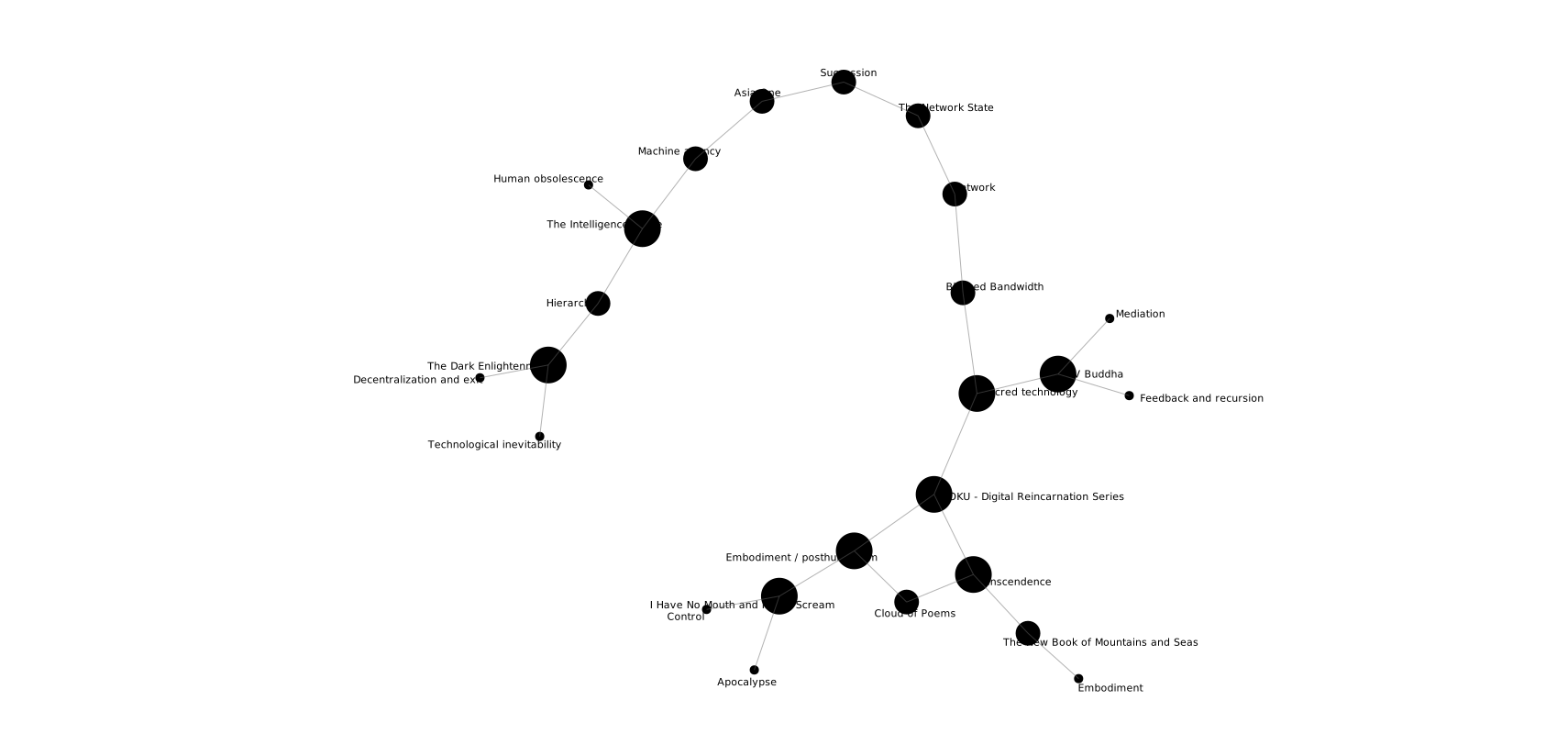
This Palladio network maps conceptual relationships across selected Divine Machinery artworks, fiction, and techno-political texts. Each work or text is connected to recurring themes such as sacred technology, machine agency, transcendence, succession, hierarchy, and human obsolescence. Rather than implying direct historical influence, the visualization highlights conceptual resonance—showing where otherwise different cultural objects converge around shared questions of technological power, human agency, and the possibility of posthuman futures.
The Trilogy (Canva Infographic)
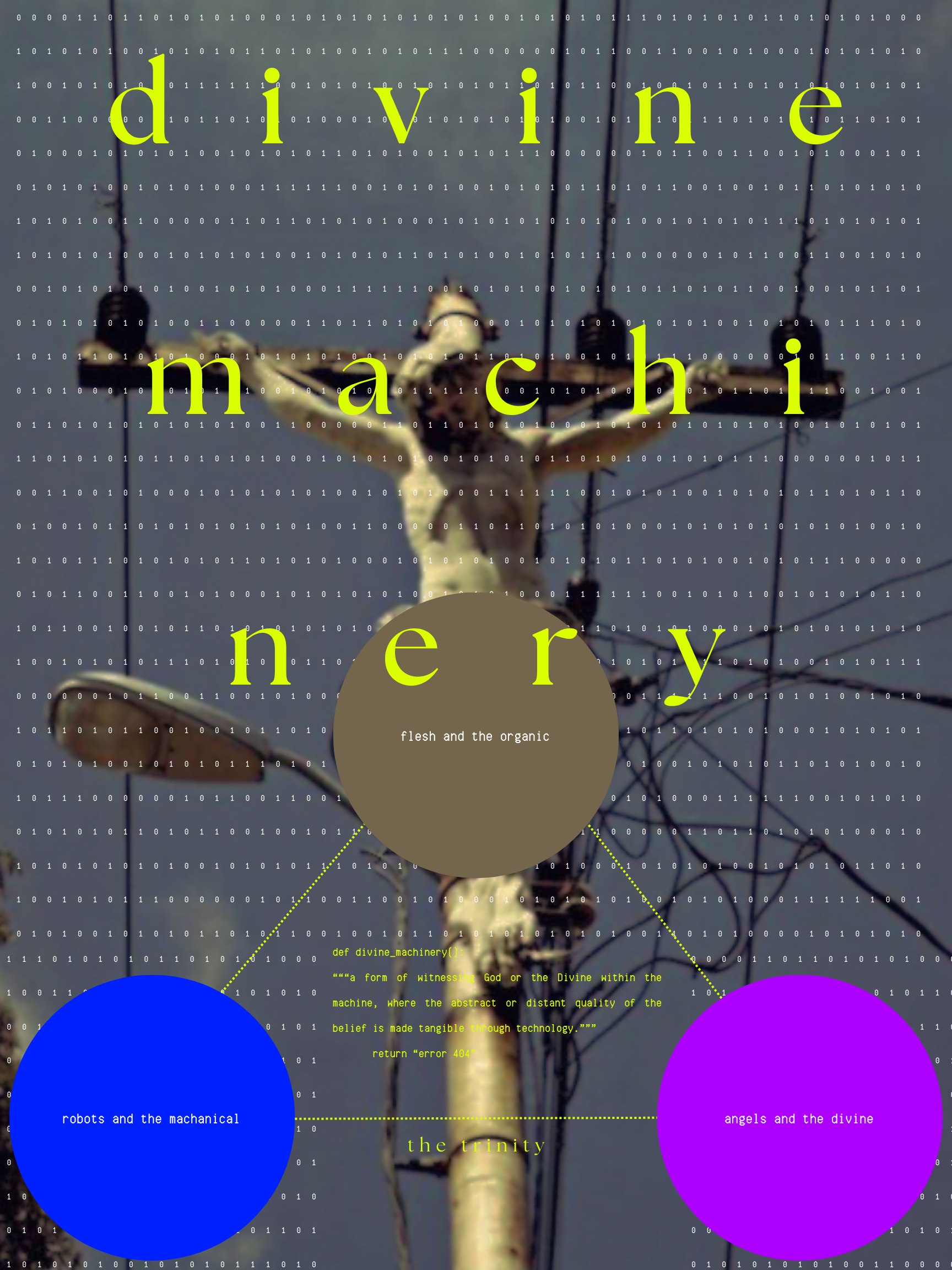
This infographic presents Divine Machinery as a trinity of the organic, the mechanical, and the divine. The three connected circles frame the aesthetic as a meeting point between flesh, machines, and spiritual symbolism, suggesting that technology can make distant or abstract ideas of divinity feel tangible. Visually, the suspended mechanical figure merges crucifixion imagery with wires and machinery, while the field of binary code places the sacred image inside a digital environment. The luminous typography, saturated circles, and network-like lines create a tension between reverence and artificiality, giving the composition the feeling of a technological altar or diagram of a new machine-based faith.