Is It Time?
a foreword to the digital exhibition ATLAS. By Jacqueline Song
Long flights - especially those that cross oceans - mean more to me than a stage of transportation. On these flights, I often catch myself thinking: thinking of where I have just left, where I am going, and when I will come back - if back is even the right word. I think of my past and my future. Presence becomes an abstraction.
This is my imperfect attempt to describe what migration feels like - or, more specifically, how migration transforms time as it is experienced by the migrant. Yet I am becoming increasingly aware that the difficulty is not only finding the right words. It is also deciding what forms of evidence can hold such an experience. A flight record can tell me that UA862 departed Hong Kong at 12:30 p.m. and arrived in San Francisco at 9:56 a.m. It can measure duration, distance, delay, and changes in time zone. But it cannot explain whether I was leaving home or returning to it.
Michelle Caswell's discussion of archival records has made me more cautious about treating documents as neutral
containers of the past. Records do not simply preserve reality; their format, purpose, and conditions of creation
determine what becomes visible and what remains silent. Caswell writes that silences can be embedded within records
from the moment they are made. In her account, bureaucratic photographs did not merely document their subjects but
produced institutional identities for them, transforming individuals into objects that could be classified and administered.
Although the records in my project emerge from an entirely different context, the reading prompts me to ask a related question:
My spreadsheet organizes a flight into date, flight number, origin, destination, scheduled departure, actual arrival, duration, and direction of travel. This structure makes the journey legible to a computer, but it also strips away the hours of thought, uncertainty, anticipation, boredom, and bodily disorientation that occurred between those fields. The database therefore will not operate as an unquestioned record of my movement. Instead, I want to make its absences visible by placing measured time beside remembered time, time experienced.
Valeria Luiselli’s Tell Me How It Ends similarly considers what happens when an experience of migration must be translated into an official documentary form. The stories she hears do not arrive in orderly sequences. They are hesitant, fragmented, and resistant to being compressed into the empty spaces of a questionnaire. Luiselli describes the difficulty of transforming complicated spoken narratives into succinct written terms, noting that the stories lack the clear beginning, middle, and end that official systems expect. Her account reminds me that fragmentation is not necessarily a failure of documentation, rather, the silence is a more truthful form for experiences in which departure, arrival, past, and future cannot be neatly separated.
For that reason, my project will not follow a single chronological narrative. Its foundation will be a painting I created around the same theme. Rather than treating the painting as an illustration or an object to be observed from a distance, I will turn it into an interactive reception point. Viewers will be able to move through the image and enter separate “galleries” through symbols embedded within it. Like memory, the project will be navigated associatively: one location, image, sound, or object may unexpectedly open onto another.
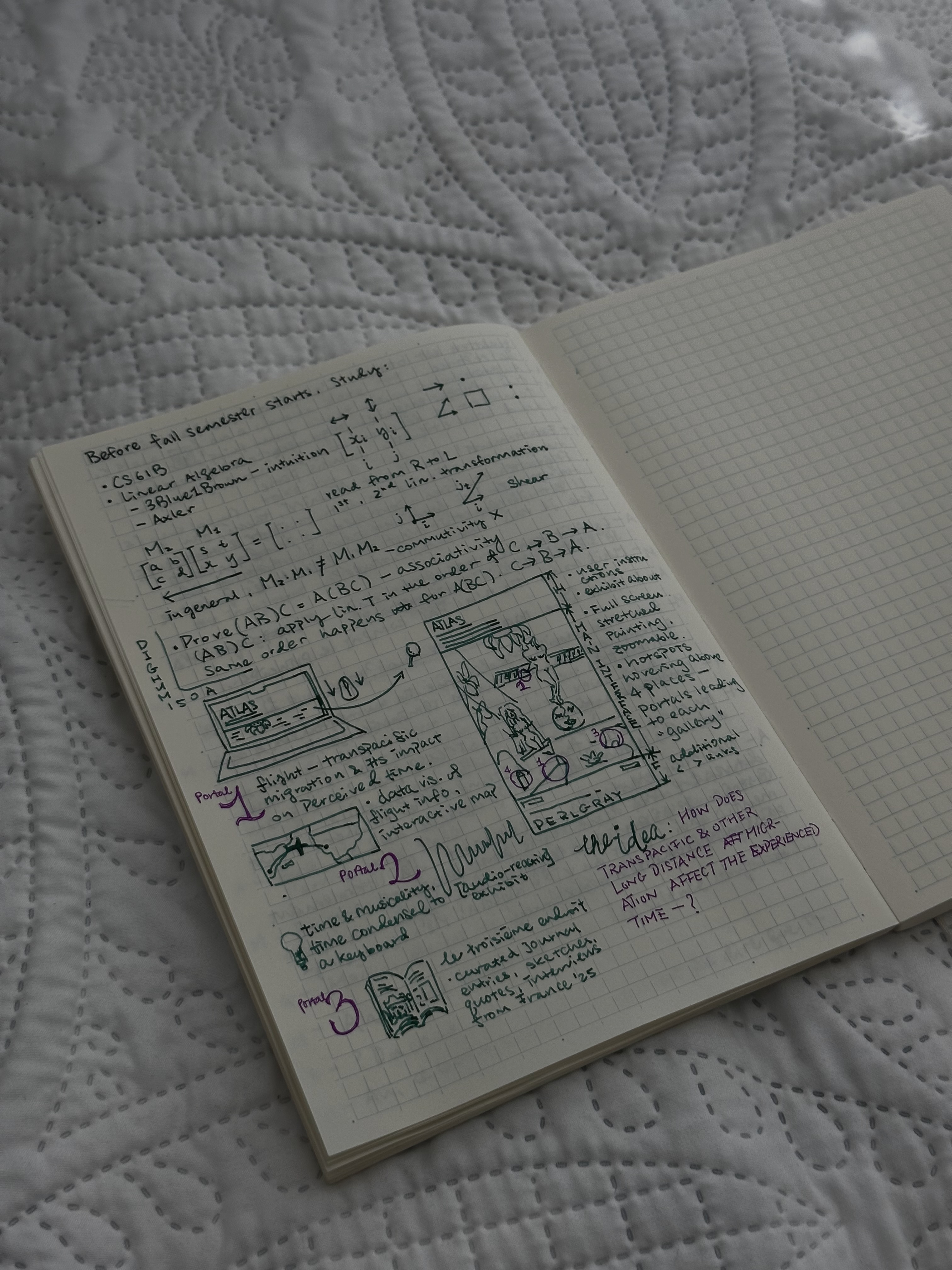
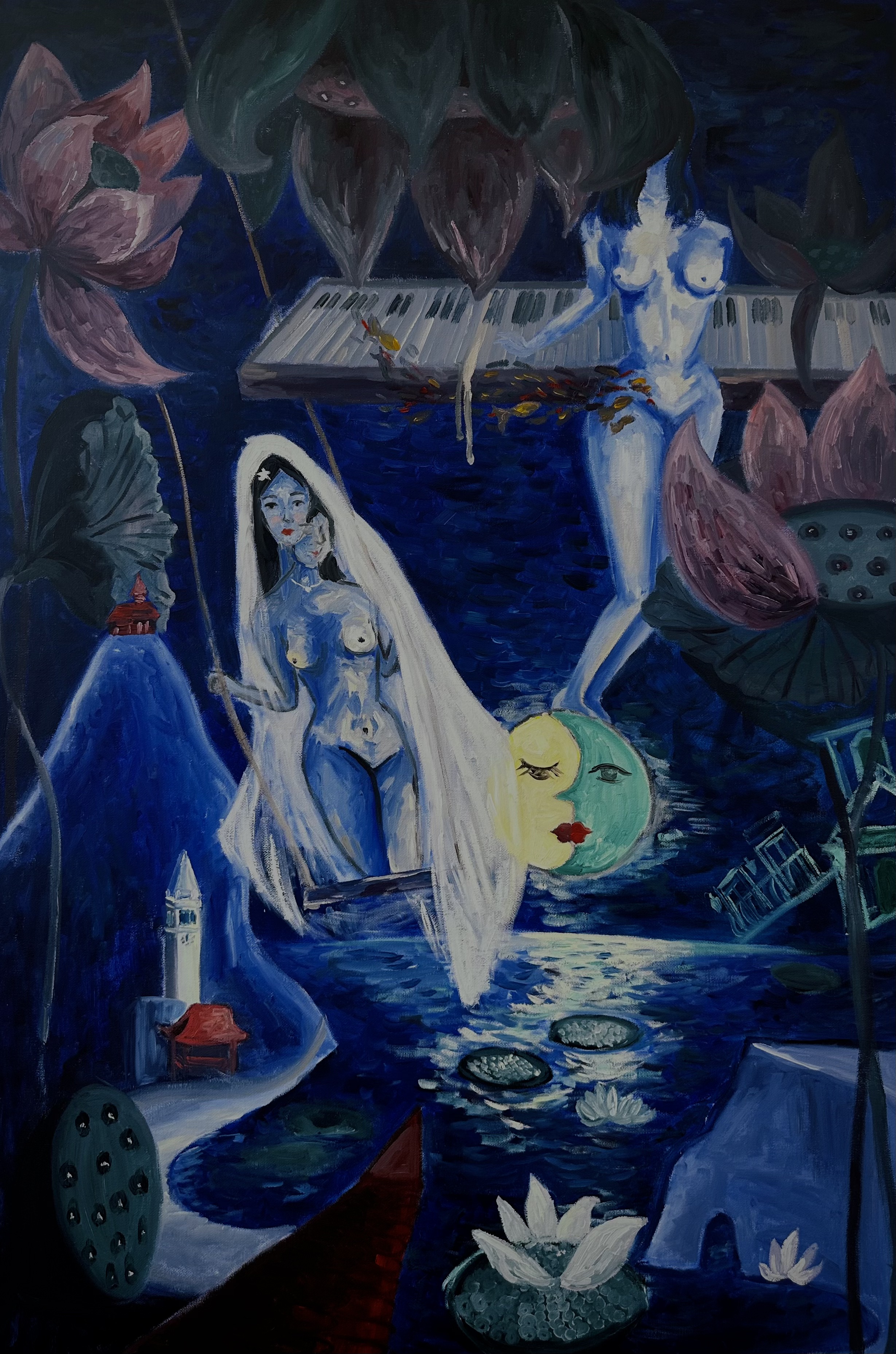
The first portal rests on the plane wing at the bottom left of the painting. Inside, an interactive cartography will trace flights that have been significant to my life. The map will draw upon flight numbers, airport coordinates, routes, durations, time zones, and departure and arrival records. These fields offer one documentary way of knowing a journey: the flight becomes a measurable movement between geographic points.
The second portal is located on the cliff at the right side of the painting. It depicts la Falaise D'Étretat, my favorite place from the summer I studied abroad in France - le troisième endroit, the third place outside the plane formed by my home country and California. This gallery will include extracts from my journal, sketches, photographs, interviews, and objects associated with ordinary life during that period.
The District Six Huis Kombuis cookbook has helped me understand how seemingly ordinary materials can document displacement and belonging. Rather than separating recipes from the people and places surrounding them, the cookbook presents food memories as inseparable from memories of homes, streets, rituals, relationships, and community. The book challenges the idea that documentary knowledge must come primarily from official files or monumental historical events. Memory can also remain in a dish, a repeated gesture, a family story, or the texture of an ordinary day. I want to approach my own materials with a similar attention to the everyday. My journal and photographs will not offer a comprehensive account of France, nor will they claim to document study abroad objectively. They will instead record how a temporary place became meaningful through routines: where I walked, what I painted, which views I returned to, what I ate, and when I began to feel familiar with the landscape. The gallery will treat these small and subjective traces not as secondary supplements to “real” records, but as ways of knowing place in their own right.
The third gallery begins on the piano keys. It will take the form of an audio-reactive visual environment exploring how music is experienced through time. For most of my life, the piano has been my most trusted confidant. Wherever there is a piano, I can find a small piece of home, regardless of time or place. Unlike most visual archival forms, music cannot be perceived all at once -- it unfolds through duration. The listener holds traces of the notes that have disappeared while anticipating notes that do not yet exist. The present is therefore never completely self-contained: it is formed through memory and expectation. The piano gallery will use sound, motion, repetition, and visual response to explore this less measurable experience of time.
Together, these galleries will incorporate multiple ways of knowing: numerical data, cartography, archival records, personal testimony, painting, photography, drawing, everyday objects, sound, bodily experience, and memory. I do not intend to oppose subjective memory to objective documentation as though one must be true and the other false. Rather, I want to examine what each form makes visible and what each form silences.
Is It Time? will move between different and sometimes contradictory forms of evidence. Its structure will remain partial, associative, and open-ended. Migration, after all, does not always produce a story with a clear beginning, middle, and end. Sometimes it produces a collection of records whose meanings change depending on where, and when, you are standing.